


Kartik Chugh · June 4, 2026
Through Q4 2025 we were telling small-business operators to delegate harder, hire faster, and buy better tooling. The 2026 data corrected us. Across 42 operators we tracked through Q1, the ones who scaled none of those three but doubled down on a fourth move outpaced their peers by a wide margin.
The fourth move was operator-time reclassification. Specifically: separating decision-time (where the founder still owns the call) from execution-time (where agents and the small team ship without the founder in the room) and protecting the calendar accordingly. The compounding businesses spent 18 percent of founder time on decisions and zero percent on execution. The leaking ones spent 8 percent on decisions and 31 percent reviewing execution work that should have shipped without them. The agents and the small team ship fine. What separates the best operators in 2026 is the rigor with which they gate output before it ships, the cadence at which they audit voice drift, and the protocols they wrote for handling the four failure modes AI marketing automation introduced.
This is the leadership upgrade we documented across the cohort. Three management disciplines that became table stakes in 2026 and are still optional for most operators we audit.
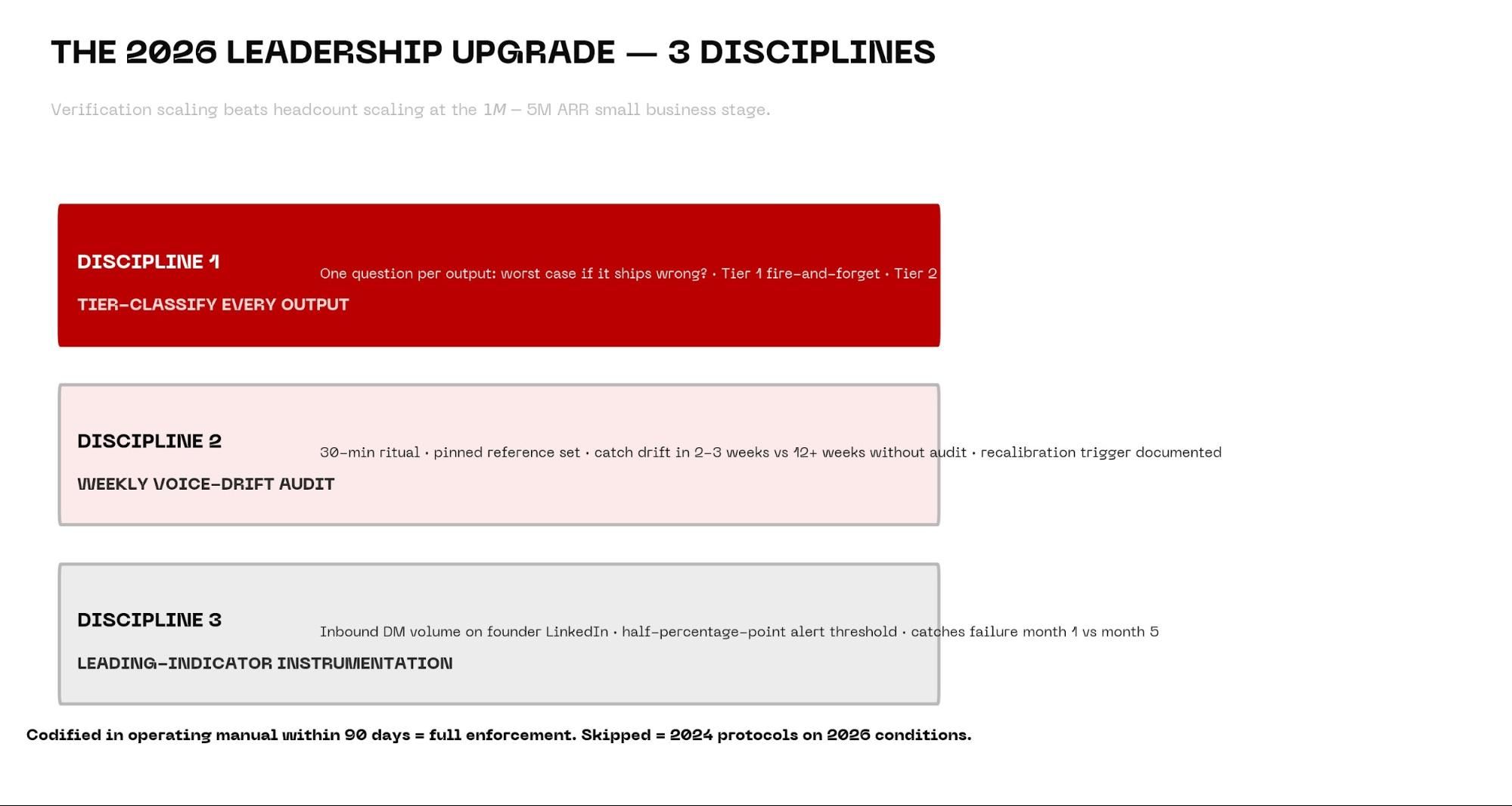
Discipline 1. Tier-classify every output before the team ships it
The most impactful management change in 2026 was making tier-classification a first-class workflow, not an afterthought. The framework we run with every retainer is a single question per output: what is the worst case if this ships wrong? Tier 1, cheap and reversible (delete and resend, no review needed). Tier 2, gradual trust decay if skipped (cold-email sequences, founder LinkedIn posts, blog drafts; two-minute human read before ship). Tier 3, asymmetric public consequence (ad claims, case-study stats, anything legally adjacent; human review plus 12-month audit trail).
Across the cohort, operators who codified this tier-classification into their team operating manual saw 50 percent reduction in trust-decay incidents inside 6 months. Operators who treated tier-classification as informal or optional saw the same volume of incidents as operators with no framework at all. The discipline is not the framework itself, every team can describe the framework. The discipline is enforcing it on every output, every time, without exception. Operators who let "small" Tier-2 outputs ship through Tier-1 review (because the deadline was tight or the client was urgent) saw the trust signal leak in exactly the pattern the framework predicts.
Discipline 2. Voice-drift audits as a standing weekly ritual
The second management upgrade is recognizing voice drift as a measurable, recurring failure mode that requires a standing audit ritual, not an ad-hoc spot check. Across the cohort, operators saw voice drift accumulate over 8-12 weeks when AI agents shipped content without periodic recalibration. The drift mechanism is structural, agents trained on the operator's earlier output produce smoothed-out, AI-adjacent content; that content gets republished and re-ingested as training context; the next batch drifts further from the founder's actual voice; AI search assistants increasingly penalize the smoothed-out tone.
The operating-discipline fix is a 30-minute weekly voice audit. The leader (founder or designated head) reads 5-10 randomly sampled pieces of agent-generated output from the prior week, compares against a pinned reference set of 10-15 founder-handwritten pieces, and flags any drift. Drift triggers a recalibration, refresh the reference set, retrain the agent prompt, reduce the agent's output frequency for 2-4 weeks until the voice locks back to baseline. Across the cohort, operators who ran the weekly audit caught drift inside 2-3 weeks of onset; operators who skipped the audit did not catch drift until inbound DM volume had decayed 30-40 percent, a 2-3 month delay with compounding cost.
Discipline 3. Leading-indicator instrumentation, not lagging metrics
The third leadership shift is operators who instrumented the right leading indicator and built a half-point alert threshold around it. Across the cohort, the most reliable leading indicator of marketing operating-layer failure was inbound DM volume on the founder's LinkedIn. The metric started declining at week 4-6 of mismatched verification, accelerated through month 3, and hit 50 percent below baseline by month 6. Operators who only watched lagging indicators (revenue, MQL volume, content output count) did not catch the failure until month 5 or 6, by which point recovery took 14-plus weeks.
The instrumentation is straightforward but rare. Each Friday, count the inbound DM volume on the founder's LinkedIn for the prior 14 days. Compare against the rolling 30-day baseline. Any half-percentage-point drop triggers an immediate audit of agent output quality, verification-tier compliance, and voice drift. The discipline is the half-point trigger, most operators wait for a 2-3 percentage point drop before reacting, by which point the failure has compounded for 4-6 weeks.
Why these three disciplines beat the 2024 leadership playbook
The 2024 small business leadership playbook focused on scaling headcount, scaling tooling, and scaling marketing spend. All three were the right answer when production was the bottleneck. In 2026, AI agents made production cheap and abundant; the bottleneck moved to verification, calibration, and instrumentation. Operators who continued running the 2024 playbook in 2026, adding people, adding tools, adding spend, saw diminishing returns because the throughput went up but the trust signal went down. Operators who shifted their leadership discipline to the three above saw inbound trust signals climb on roughly the same revenue and headcount footprint.
The shift is uncomfortable for many small business operators because the new leadership work is unglamorous. Tier-classifying every output is bureaucratic. Voice-drift audits feel paranoid. Leading-indicator instrumentation requires sitting with a half-percentage-point drop instead of celebrating last quarter's revenue beat. The cohort founders that ran these disciplines reported the work felt like an opportunity cost in the first 30 days and an unmistakable competitive advantage by month four.
The team operating-manual update
Codifying these disciplines into the team operating manual is the leadership work. Across the cohort, the operations that updated their operating manual in early 2026 had the framework live and enforced by Q2; the operations that left it informal still hadn't updated by Q4 and were running 2024 protocols against 2026 conditions.
The operating manual update has three sections. First. Tier-classification matrix with examples for each tier specific to the operator's marketing surfaces. Second. Voice-drift audit protocol with the pinned reference-set location, the audit cadence, the recalibration trigger, and the agent-prompt update sequence. Third. Leading-indicator dashboard with the metric, the baseline, the alert threshold, and the responder matrix (who acts on what trigger). The manual sections are short, 2-3 pages each. The leadership commitment is enforcement, not document length.
The cohort signal
n=42 small-to-mid B2B operators · 50% reduction in trust-decay incidents when tier-classification was enforced as standing protocol · 2-3 week vs 12+ week voice-drift detection lag for operators running weekly audits vs no audit · Half-percentage-point inbound-DM-volume threshold caught failure at month 1 vs month 5 with lagging indicators alone · 90-day average implementation timeline from operating-manual update to fully enforced workflow (FORKOFF Founder-Funnel Cohort 2026)
What 42 operators wished they had done at $1M ARR
The hindsight pattern is consistent across the cohort. Operators who hit the $5M ARR mark in 2026 with healthy inbound metrics consistently said they wished they had codified the three disciplines at the $1M ARR stage rather than waiting until $3M-$5M. The cost of late codification is two-fold. First, retroactive cleanup of voice drift that compounded for 6-12 months before the protocol was added. Second, retroactive cultural rebuild, teams that worked under informal verification standards for 12-18 months resist the formalization, even when the data shows the formalization is working.
The operators who built the disciplines into the company's first 18 months had no resistance because the disciplines were always part of how the team operated. The earlier the codification, the cheaper the enforcement, and the cleaner the scaling curve.
What to do this month
Three leadership actions move a small business operation from 2024-stack to 2026-stack inside 30 days. First, codify the tier-classification matrix in writing and circulate to the team within seven days; enforce on every output the following month. Second, set up the voice-drift audit ritual, pinned reference set, weekly 30-minute audit, recalibration trigger documented. Third, instrument the leading indicator (inbound DM volume on the founder's LinkedIn) with a half-point alert threshold and assign a responder. None of these require new headcount, new tooling, or new budget. They require leadership willingness to enforce three small disciplines consistently against the daily operational pressure to skip them.
The 2026 small business leadership shift is not about scaling people. It is about scaling discipline. The operators who get this right inside the next 12 months will compound through 2027-2028. The operators who keep running the 2024 playbook will leak share quietly while their dashboards still look fine for the first 4-6 months.
FAQ
At what stage does this matter most?
$1M-$3M ARR is the highest-leverage window because the team is small enough that protocol changes propagate fast and the scaling pressure has not yet locked in 2024-era habits. Above $5M, the cultural retrofit cost rises sharply. Below $1M, the founder is verifying everything personally and the formal protocol can wait a quarter.
What if the team resists the new disciplines?
The most common resistance is from team members who treat verification as a slowdown of throughput. The reframe that worked across the cohort is showing the leading-indicator dashboard, when inbound DM volume is the metric, every team member can see whether the protocol is working, and the resistance fades within 4-8 weeks of seeing the trust signal stabilize.
How does this apply to a solo operator?
The disciplines compress. Tier-classification becomes a self-check rule. Voice-drift audit becomes a 15-minute weekly review. Leading-indicator instrumentation becomes a Friday check on the founder's own LinkedIn DM count. The framework scales down to one person without losing its shape.
Does this work for service businesses (not B2B SaaS)?
Yes, with one adjustment. Service businesses replace `inbound DM volume on founder's LinkedIn` with `inbound discovery-call request volume` as the leading indicator. The metric is sector-specific; the principle (instrument the earliest leading indicator, set a half-point alert) is universal.
What is the most common failure mode of operators who try to run these disciplines?
Inconsistent enforcement. Operators codify the protocol, run it for 4-6 weeks, then let it slip when a high-pressure deliverable hits. The protocol works on consistency, not effort intensity. Six weeks of disciplined enforcement followed by two weeks of skipping resets the trust signal more than nine weeks of consistent enforcement at lower intensity.