

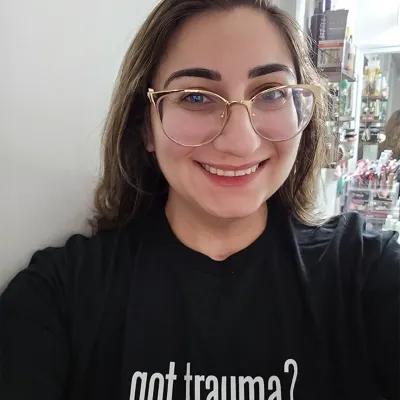
Alyssa Ostroff · June 2, 2026
On April Fools' Day 2025, I logged into work at 6am and found an email informing me that my position at the CDC had been eliminated. Effective immediately. My entire branch. My entire department. Gone overnight.
I watched it happen like a bad episode of The Apprentice — except it was real, it was my life, and it was April Fools' Day, which felt like the cruelest joke the universe could have written.
Within one month, I launched a business.
Not because I had a business plan. Not because I felt ready. Because I had four years of artwork, a therapist who believed in me, and nothing left to lose.
Here's what that year taught me about leadership — specifically the kind nobody puts in a business school curriculum.
1. Your Why Has to Be Bigger Than Your Fear
When I launched Self-Care Shirts on May 1st, 2025 — Mental Health Awareness Month — I had one sale the entire first month. One. From a former coworker who believed in me before I had any proof it would work.
Most people would have stopped there. What kept me going wasn't confidence. It was clarity about why I was doing it in the first place.
I had spent five years at the CDC using graphic design to help people access life-saving public health information. When that job disappeared, the mission didn't. Self-Care Shirts was a different medium for the same purpose: helping people feel less alone, more seen, and less ashamed of what they were carrying.
The most important leadership decision you'll make isn't strategic — it's identifying a why that can outlast your fear, your failures, and your worst days. Because those days are coming.
2. Grief Is Part of the Process — Not an Obstacle to It
Every business book tells you to pivot fast, fail forward, embrace disruption. Nobody tells you to grieve first.
I took a few days after the layoff to fall apart. I cried. I let myself feel the weight of what I'd lost — not just the job, but the identity, the purpose, the security I'd built around it.
And then I bought a domain name.
That grief wasn't wasted time. It was necessary processing that cleared the way for real action. Leaders who skip the grief — who pivot immediately and push the feelings down — tend to find those feelings surfacing later, harder, at the worst possible moments.
Give yourself and your team permission to name what's been lost before demanding forward momentum. That acknowledgment is what makes the momentum sustainable.
3. Small Wins Are a Leadership Strategy
Month one: one sale. Month two: three sales. Month three: five sales. By November 2025: profitable.
I could have measured myself against where I wanted to be and felt like a failure every single month. Instead I celebrated every milestone — each new sale, each first review, each time someone messaged me to say a shirt made them feel less alone.
Small business leadership requires you to be your own morale officer, especially when you're a solo founder. Nobody else is going to celebrate your first sale. You have to do it yourself — and mean it — or you won't survive the months when the big wins don't come.
4. Mistakes Are Tuition, Not Verdicts
I made expensive mistakes with advertising in my first months. Spent money I didn't have learning things the hard way. Lost more than I should have.
I also hold a master's degree in digital strategy. The irony was not lost on me.
The difference between founders who make it and founders who don't isn't whether they make mistakes — it's whether they treat those mistakes as tuition or as verdicts. I kept going. I got better. I made different mistakes. And eventually the compounding of those lessons became competence.
Give yourself and your team the same grace. A mistake is data. It only becomes a failure if you stop.
5. Mission-Driven Business Is a Competitive Advantage
From day one, Self-Care Shirts has donated 10% of proceeds to 988 and The Trevor Project. Not because it was strategic — because it was the right thing to do.
What I didn't anticipate was how much that commitment would shape the brand's identity, attract the right customers, and keep me going during the hard months. When your business exists for a reason beyond profit, you have a reason to keep going even when profit is thin.
In one year, Self-Care Shirts crossed 1,000 orders and has been profitable every month since November 2025. I believe the mission is part of why.
Customers can tell when a business believes in something. Build something worth believing in.
The Leadership Lesson Nobody Teaches
You don't have to feel ready to lead. You just have to start.
I launched Self-Care Shirts imperfect, scared, and figuring it out in real time. The site wasn't perfect. The ads weren't optimized. The strategy was mostly intuition and desperation.
And it worked — not because I had everything figured out, but because I had a clear mission, a willingness to learn, and enough resilience to keep going when everything felt impossible.
That, more than any strategy or framework, is what leadership actually looks like.