
Ten Lessons From Real Financial Models Help Founders Raise Capital
Small Business Leader ·
Small Business Leader · November 25, 2026 · · 4 min read
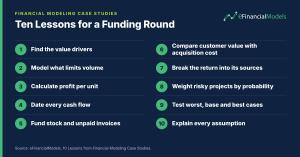
Ten lessons from real financial models help founders raise capital.
The ten lessons from financial modeling case studies for founders preparing a funding round.
A review of past custom modeling projects yields ten lessons, each shown with a real client project, for founders preparing a funding round.
Every one of these financial models was built for a real decision: a funding round, a bank loan, an acquisition or a valuation.”
— eFinancialModels
ZURICH, SWITZERLAND, November 25, 2026 /EINPresswire.com/ -- eFinancialModels today published 10 Lessons from Financial Modeling Case Studies, a review of the custom financial models its team built for clients. The ten lessons show founders which questions a financial plan has to answer before a funding round, and each lesson is explained with anonymized case studies from real projects.
“Every one of these financial models was built for a real decision: a funding round, a bank loan, an acquisition or a valuation,” said the eFinancialModels Communications Team. “Very different businesses raised the same questions, so a founder who works through the ten lessons arrives at the first investor meeting with the answers prepared.”
LESSONS FROM REAL PROJECTS
eFinancialModels states on the page that its financial modeling team has built hundreds of custom financial models for founders, project developers, fund managers and corporate teams. The projects behind the case studies include a battery recycling plant, a gin distillery, a solar park, a biogas plant, a green hydrogen project, a real estate fund, a private debt fund, a biotech company and a subscription app. The review asked what these projects teach beyond the single business.
THREE FOUNDERS, THREE TURNING POINTS
The founders of a gin distillery expected to fund new stills. The financial model showed that a sales team, stock and customer payment terms needed funding as well, because these costs are paid before the cash from sales arrives. The plan became three funding rounds, as the Gin Distillery Financial Model Case Study describes.
The founders of a subscription app asked how much to raise. The financial model compared what a subscriber is worth over time with the cost of winning one. With that picture, the founders chose to improve these numbers first and keep fundraising as an option, as the Community App Financial Model Case Study shows.
A battery recycler prepared for investor talks. Investors pressed one point: whether signed supply contracts cover the planned capacity. The financial model links processing volumes to those contracts, as the Battery Recycling Financial Model Case Study explains.
THE TEN LESSONS
1. Find the value drivers. A few assumptions move the result most, and they differ in every business.
2. Model what limits volume. Supply contracts and production capacity cap what a business can sell.
3. Calculate profit per unit. Profit per bottle, tonne or event shows where the margin is made.
4. Date every cash flow. The same sale price returns far less when the cash arrives two years later.
5. Fund stock and unpaid invoices. Growth ties up cash before customers pay.
6. Compare customer value with acquisition cost. Growth pays when a customer is worth clearly more than the cost of winning one.
7. Break the return into its sources. A breakdown shows which factors add to the return and which reduce it.
8. Weight risky projects by probability. Where success is uncertain, as in biotech, the chances of success belong in the forecast.
9. Test worst, base and best cases. Scenarios show the result when assumptions miss.
10. Explain every assumption. Transparent calculations move the discussion to the plausibility of the plan.
WHERE FOUNDERS CAN START
A financial model that follows the ten lessons shows investors and lenders how the business earns its return and what the funding pays for. Client names are withheld, the worked examples use illustrative values, and every case study can be downloaded as a PDF free of charge.
Founders can apply the lessons to their own plan with the financial model templates on eFinancialModels or with a custom financial model.
This release is for information only and does not constitute investment, financial or legal advice.
Communications Team eFinancialModels
eFinancialModels
info@efinancialmodels.com
Visit us on social media:
LinkedIn
Bluesky
Instagram
Facebook
YouTube
TikTok
X
Legal Disclaimer:
EIN Presswire provides this news content "as is" without warranty of any kind. We do not accept any responsibility or liability for the accuracy, content, images, videos, licenses, completeness, legality, or reliability of the information contained in this article. If you have any complaints or copyright issues related to this article, kindly contact the author above.
